
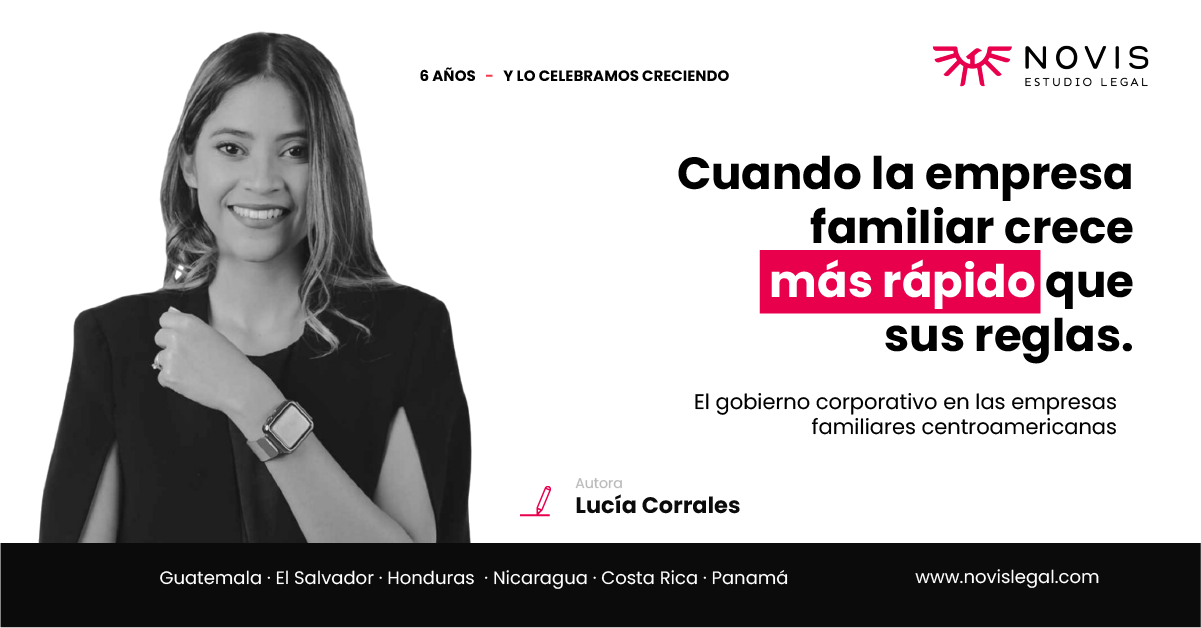
When a Family Business Grows Faster Than Its Rules: The Case of Corporate Governance in Central America
After years of working with family-owned businesses in Honduras and the region, I’ve noticed a recurring pattern: the business becomes more professional in sales, production, and finance, but important decisions are still made around the family table, without minutes or clear rules about who decides what. It works as long as the founder is at the helm. The problem arises when they step down.
Corporate governance is not a luxury reserved for multinational corporations or publicly traded companies. For a Central American family business, it is the difference between an orderly succession and a legal dispute among siblings that fragments the wealth built up over decades.
What the Law Says—and What It Doesn’t Say
In Honduras, the Commercial Code (Decree 73-50) does impose minimum governance requirements: it requires maintaining a notarized minute book of shareholders’ meetings and directors’ resolutions, and mandates the submission of an annual report each January to the Ministry of Finance (an office whose tax-related responsibilities now generally fall under the Revenue Administration Service (SAR), created in 2016) containing the annual balance sheet and a list of directors and representatives, and prohibits directors and auditors from voting on the approval of their own conduct or the balance sheet, holding them liable for any damages caused if they do so.
Some compilations of the Code also recognize a shareholder’s right to request, in writing, internal company documents, with an explicit list of items that cannot be considered corporate secrets, such as: articles of incorporation, minutes of board of directors’ meetings, minutes of shareholders’ meetings, financial statements, among others.
In other words: the Code already lays the groundwork for good governance—transparency, traceability, and a ban on conflicts of interest in voting. What it does not include are specific regulations for family businesses: it does not require family protocols, family councils, independent directors, or succession policies. That aspect depends entirely on what the family decides to agree upon.
The region is not uniform
A common mistake is to assume that “this is how it works throughout Central America.” That is not the case. In Guatemala, the Commercial Code (Decree 2-70) requires that the form of management—sole manager or board of directors—be expressly defined, and when a board is chosen, registration and notarial practice requires it to consist of at least three members, clearly distinguishing between the governing body, the shareholders’ meeting, and the supervisory body. In Honduras, on the other hand, the Commercial Code does not set a minimum number of board members—that decision is left to the shareholders to agree upon in the articles of incorporation.
In Panama, Law 32 of 1927 requires a minimum of three directors on the Board of Directors, plus officers (president, secretary, treasurer), but allows meetings to be held outside the country and does not require Panamanian residency or citizenship. It is a flexible law by design, intended for international structures, which imposes no governance discipline beyond the formal requirements: the entire burden of regulating the relationship between family, ownership, and management falls on the articles of association and private documents.
Why Isn’t Commercial Law Enough?
No commercial code in the region regulates what is, in practice, the most common source of conflict: the overlap between the roles of family member, shareholder, and executive. This is precisely what is documented in the IFC Family Business Governance Handbook, published by the International Finance Corporation, which states that as the company grows and new generations join, it is essential to distinguish between family governance and corporate governance through mechanisms such as a family constitution, employment policies for family members, and a board of directors with clearly defined roles.
More broadly, the G20 and OECD Principles of Corporate Governance—an international benchmark, revised in 2023 and endorsed by the G20 that same year—emphasize that the protection of shareholders’ rights, equitable treatment among them, and clarity regarding the responsibilities of the board of directors are prerequisites for the sustainability of any company. They serve as a benchmark for best practices—not a legally binding standard in Central America—and do not replace each country’s commercial laws.
Practical Implications and Risks
Without formal governance, what I often see is: decisions made without minutes or supporting documentation, which are difficult to justify to banks or during due diligence; a lack of mechanisms to resolve disagreements among partners who are also relatives; a lack of objective criteria for bringing in the next generation; and gaps regarding what happens to shares in the event of a partner’s death, incapacity, or divorce—situations that, without an express agreement, are subject to general succession rules, which are not always aligned with the continuity of the business.
Recommended Best Practices
Establish a board of directors that meets regularly and keeps minutes in accordance with applicable law; separate, at least on paper, family matters from corporate matters, following the approach outlined in the IFC handbook; adopt a family protocol or shareholders’ agreement that governs the admission and withdrawal of shareholders, the employment of family members, and conflict resolution mechanisms; document in writing the criteria for succession in management; and periodically review the articles of incorporation to ensure they reflect how the company actually operates.
A Final Thought
Commercial law sets the minimum requirements: books, minutes, reports, and the basic duties of managers. Everything else—how the family and the business coexist, how the next generation is prepared, how a disagreement among siblings who are business partners is resolved—depends on decisions that the business family must make in advance. The question is not whether the company needs these rules, but whether it prefers to write them down now, calmly, or let a future conflict dictate them.
Sources consulted
- Commercial Code of Honduras, Decree No. 73-50, National Congress of Honduras, February 17, 1950. https://www.wipo.int/wipolex/es/legislation/details/2143
- G20/OECD Principles of Corporate Governance 2023, OECD, adopted on June 8, 2023, endorsed by the G20 in September 2023. https://www.oecd.org/en/publications/g20-oecd-principles-of-corporate-governance-2023_ed750b30-en.html
- IFC Family Business Governance Handbook, International Finance Corporation (World Bank Group), 2011. https://www.ifc.org/en/insights-reports/2011/ifc-family-business-governance-handbook
- Law No. 32 of 1927, on Corporations, Republic of Panama, February 26, 1927. https://www.oas.org/juridico/spanish/mesicic3_pan_ley32.pdf
- Guatemalan Commercial Code, Decree No. 2-70, Congress of the Republic. Accessed via the Registry Classification Guide, General Commercial Registry of Guatemala: https://principal.registromercantil.gob.gt/wp-content/uploads/2024/01/Guia-Registral-de-Sociedades-Nuevas.pdf



No responses yet